
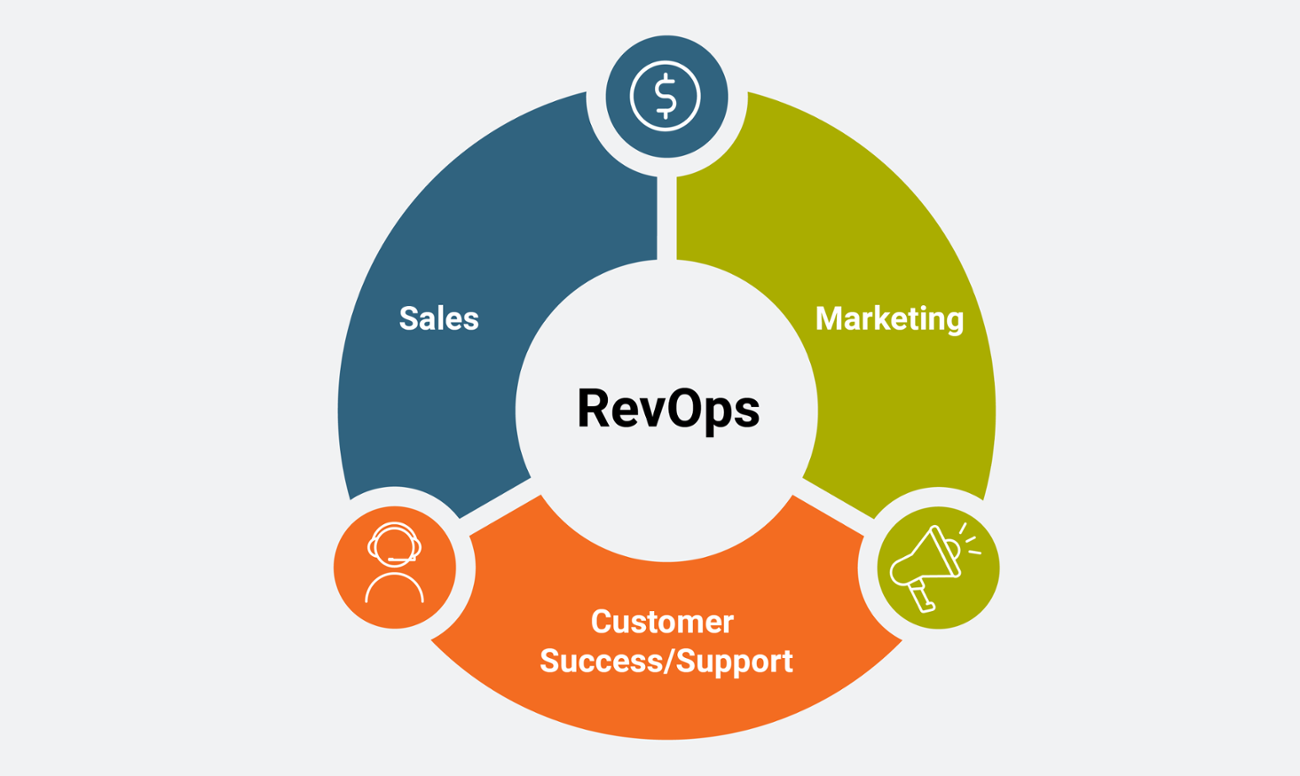
In today’s competitive business landscape, revenue growth is no longer the responsibility of a single department. Sales, marketing, and customer success must operate as a unified engine rather than isolated teams. This is where Revenue Operations (RevOps) comes in. RevOps is a strategic approach that aligns processes, technology, data, and performance metrics across all revenue-generating functions to drive predictable and scalable growth. Instead of working in silos, teams collaborate around a shared revenue goal, ensuring that every stage of the customer journey is optimized.
Understanding Revenue Operations (RevOps) –
Revenue Operations, commonly known as RevOps, integrates sales operations, marketing operations, and customer success operations into a single cohesive framework. Traditionally, these teams functioned independently, each with its own tools, KPIs, and reporting structures. Marketing focused on leads and campaigns, sales concentrated on closing deals, and customer success prioritized retention and renewals. RevOps eliminates these fragmented workflows by creating centralized ownership of revenue processes, systems, and analytics.
By aligning teams under one operational strategy, organizations gain clearer visibility into the entire revenue lifecycle—from lead generation to customer expansion.
The Problem with Departmental Silos –
Silos create inefficiencies that directly impact revenue performance. When marketing and sales operate independently, lead handoffs become inconsistent, qualification criteria may differ, and reporting metrics often conflict. Similarly, if customer success is not integrated into the revenue conversation, opportunities for upselling, cross-selling, and churn reduction are missed.
These disconnects lead to poor forecasting accuracy, inconsistent customer experiences, and misaligned incentives. RevOps addresses these challenges by standardizing processes, consolidating data systems, and establishing shared KPIs across departments.
Core Pillars of a Successful RevOps Strategy –
A strong RevOps framework is built on four primary pillars: process, technology, data, and people. First, processes must be mapped across the entire customer lifecycle to eliminate redundancies and improve workflow efficiency. Second, technology stacks—such as CRM, marketing automation, and customer success platforms—must be integrated to ensure seamless data flow. Third, data governance and reporting standards should be unified to provide consistent revenue insights. Finally, teams must align around common revenue objectives, with incentives structured to promote collaboration rather than competition.
When these pillars work together, organizations achieve operational clarity and revenue predictability.
Aligning Sales, Marketing, and Customer Success –
In a RevOps-driven organization, alignment begins with shared definitions and goals. Marketing and sales must agree on what qualifies as a marketing-qualified lead (MQL) and a sales-qualified lead (SQL). Sales and customer success must collaborate on onboarding strategies and expansion opportunities. Instead of optimizing for isolated metrics, teams focus on collective outcomes such as customer lifetime value (CLV), revenue growth rate, and net revenue retention.
This alignment ensures that the customer journey remains consistent, from initial engagement to long-term partnership.
Technology’s Role in Enabling RevOps –
Technology is a critical enabler of RevOps success. Platforms like Salesforce, HubSpot, and Gainsight often form the backbone of integrated revenue systems. When properly connected, these tools provide a unified view of pipeline performance, campaign effectiveness, and customer health metrics.
However, simply implementing tools is not enough. RevOps requires intentional system architecture, standardized data models, and real-time reporting dashboards that serve all revenue teams equally. The goal is to move from fragmented reporting to a single source of truth.
Benefits of Implementing RevOps –
Organizations that adopt RevOps experience measurable improvements in forecasting accuracy, operational efficiency, and customer retention. By consolidating revenue data, leadership gains better visibility into performance trends and can make informed strategic decisions. Teams operate with greater transparency, reducing friction during lead handoffs and customer transitions.
RevOps also improves scalability. As businesses grow, aligned processes and centralized operations prevent the chaos that often accompanies rapid expansion. Instead of rebuilding systems repeatedly, organizations scale with a structured revenue engine already in place.
Organizational Structure and Leadership –
Successful RevOps implementation often involves appointing a Head of Revenue Operations or a RevOps team that reports directly to executive leadership. This central team oversees systems management, analytics, enablement, and process optimization across sales, marketing, and customer success. By removing operational responsibilities from individual departments, RevOps allows revenue teams to focus on execution while ensuring consistency and accountability at the operational level.
Leadership commitment is essential, as RevOps transformation requires cultural change as much as technical alignment.
Measuring Success in a RevOps Model –
Key metrics in a RevOps environment extend beyond isolated departmental KPIs. Instead of focusing solely on lead volume or quota attainment, organizations track end-to-end metrics such as revenue growth rate, pipeline velocity, customer acquisition cost (CAC), lifetime value (LTV), churn rate, and net revenue retention. These metrics provide a holistic view of revenue health and highlight areas for continuous improvement.
Unified dashboards and shared reporting frameworks ensure that all teams interpret performance data consistently.
Conclusion –
Revenue Operations is more than an operational framework—it is a strategic transformation that breaks down silos and creates a unified revenue engine. By aligning sales, marketing, and customer success around shared processes, technology, and goals, organizations can drive predictable growth and deliver consistent customer experiences.
In an increasingly competitive market, companies that adopt RevOps position themselves to scale efficiently, respond quickly to change, and maximize lifetime customer value. Breaking silos is not just about collaboration—it is about building a sustainable foundation for long-term revenue success.