
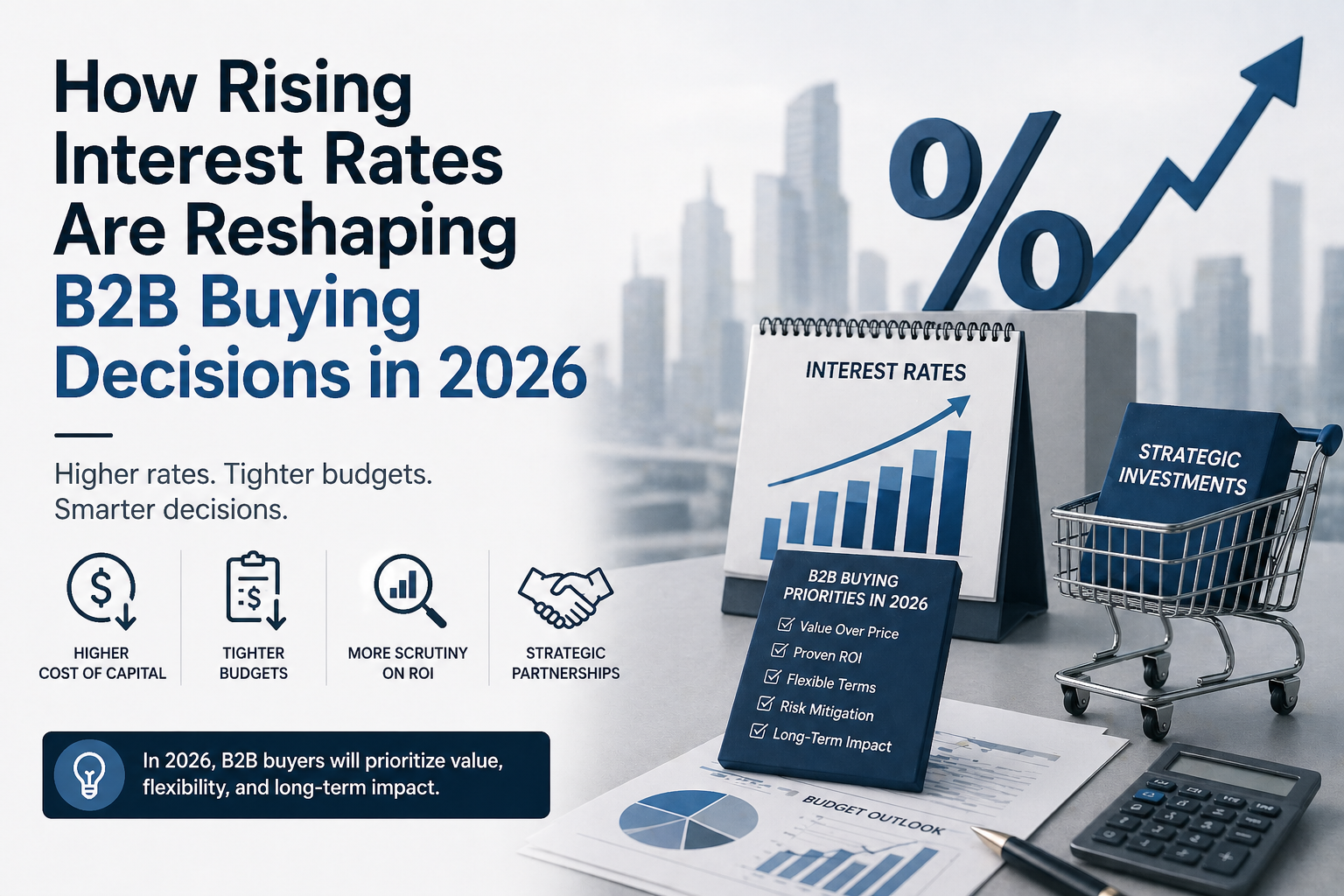
Capital Has Become Expensive—And That Changes Everything –
Rising interest rates in 2026 have fundamentally shifted how businesses think about spending. Earlier, companies were more willing to invest in growth, expansion, and experimentation because borrowing money was relatively cheap. Now, with higher capital costs, every investment is evaluated through a financial lens. Businesses are prioritizing liquidity, profitability, and stability over aggressive scaling. This means even necessary tools or services face deeper scrutiny before approval. Leadership teams are asking tougher questions and delaying commitments unless outcomes are clearly defined.
- Higher borrowing costs reduce available budgets
- Investments are treated as financial risks, not just opportunities
- CFOs play a bigger role in decision-making
- Focus shifts from growth to profitability
- Businesses prioritize essential spending only
Longer Sales Cycles Are the New Normal –
One of the most visible effects of rising interest rates is the slowdown in B2B buying cycles. Decisions that once took weeks now stretch into months due to increased caution and internal reviews. Companies are not necessarily rejecting purchases—they are delaying them. This delay often comes from uncertainty, risk aversion, and the need for multiple approvals. Buyers want to ensure they are making the right choice, especially when mistakes can be costly in a high-interest environment. Sales teams are finding it harder to maintain momentum as deals stall midway. Even after initial agreement, approvals can get stuck in finance or procurement departments.
- Decision-making timelines are significantly extended
- Deals often stall during approval stages
- Increased internal reviews slow down progress
- Buyers hesitate due to financial uncertainty
- Sales forecasting becomes less predictable
Buying Committees Are Growing in Size and Influence –
In 2026, B2B purchasing is no longer driven by a single decision-maker. Rising interest rates have increased the perceived risk of investments, leading to more stakeholders getting involved. Finance teams, procurement officers, compliance experts, and department heads all contribute to the final decision. This creates a complex web of opinions, priorities, and concerns that must be addressed. Each stakeholder evaluates the purchase from a different perspective, making consensus harder to achieve. As a result, vendors must communicate value in multiple ways—financial, operational, and strategic. The process becomes less about convincing one person and more about aligning an entire group.
- 6–10+ stakeholders are involved in most B2B decisions
- Procurement teams have greater authority
- Financial and compliance reviews are stricter
- Consensus-building becomes essential
ROI, Proof, and Risk Reduction Drive Decisions –
With higher interest rates, businesses are no longer willing to take chances on unproven solutions. Every purchase must demonstrate clear and measurable return on investment. Buyers demand case studies, real-world examples, and data-backed outcomes before committing. There is also a growing preference for pilot programs or trial periods to test effectiveness before full-scale adoption. Risk reduction has become a top priority, influencing every stage of the buying process. Vendors that cannot clearly articulate value or prove results are quickly eliminated.
- Strong emphasis on measurable ROI
- Demand for case studies and proven success
- Preference for trials and pilot programs
Pricing Pressure and Vendor Consolidation –
Rising interest rates have created a challenging environment for both buyers and sellers. Buyers are more price-sensitive due to limited budgets, while sellers face increased operational costs. This leads to tougher negotiations and pressure on profit margins. At the same time, companies are reducing the number of vendors they work with to simplify operations and cut costs. Instead of multiple suppliers, businesses prefer fewer, more reliable partners who can deliver consistent value. This trend is driving consolidation across industries. Vendors must now compete not just on price, but also on trust, reliability, and long-term value. Flexible pricing models and customized offerings are becoming essential to close deals.
- Increased price sensitivity among buyers
- Stronger negotiation dynamics
- Margin pressure on vendors
Conclusion –
Rising interest rates in 2026 are not just influencing financial markets—they are reshaping the entire B2B buying landscape. Businesses are becoming more cautious, analytical, and risk-averse in their decisions. Longer sales cycles, larger buying committees, and a stronger focus on ROI are now standard. Vendors must adapt by offering clear value, reducing risk, and building trust at every stage of the buying journey. In this environment, success depends on understanding the financial pressures buyers face and aligning solutions accordingly. Companies that can make their offerings feel necessary, reliable, and financially sound will be the ones that continue to grow despite economic constraints.