
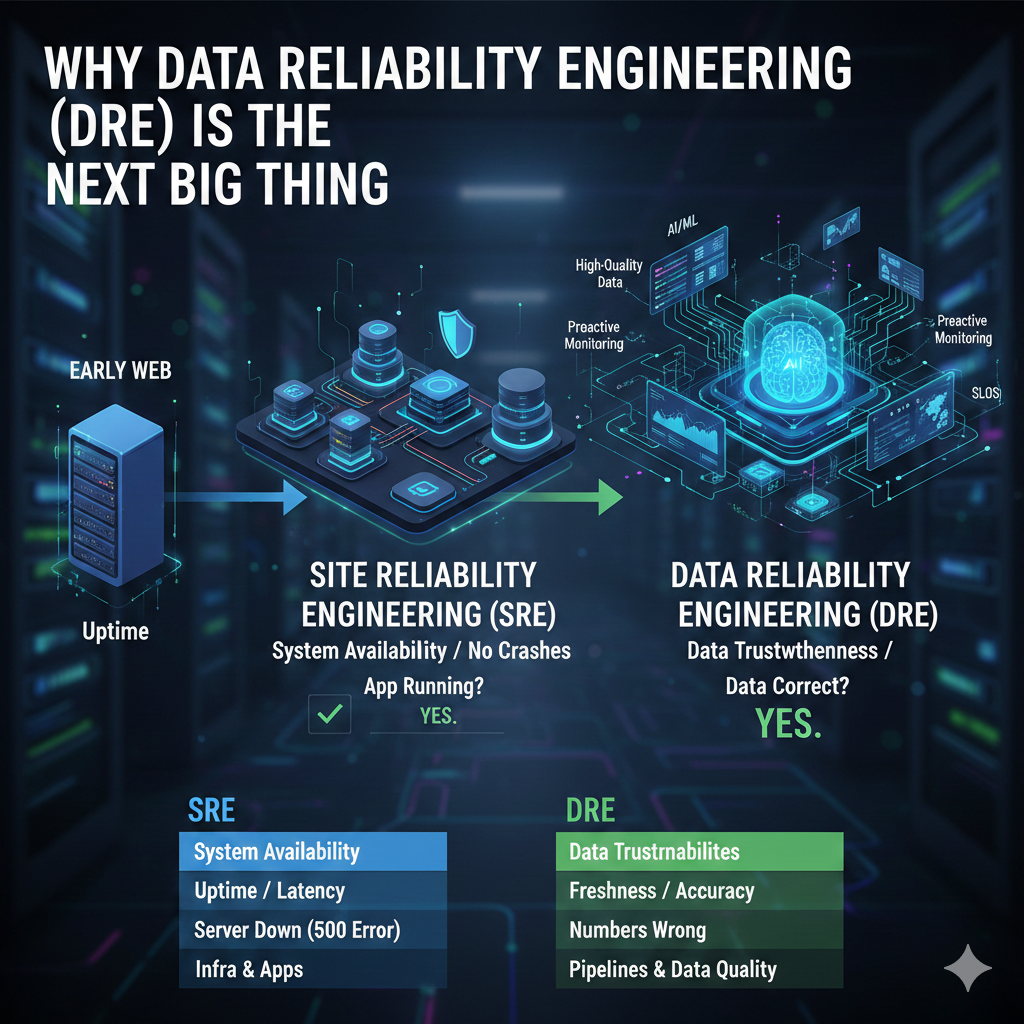
Data has become the backbone of modern decision-making. From executive dashboards to AI-driven predictions, organizations rely heavily on data to guide strategy, operations, and customer engagement. Yet as data ecosystems grow more complex, ensuring that data is accurate, timely, and trustworthy has become increasingly challenging. Traditional data engineering focuses on building pipelines and moving data efficiently—but it does not always guarantee reliability. This gap has given rise to a new discipline: Data Reliability Engineering (DRE).
DRE is emerging as the next major evolution in enterprise data strategy because it addresses a fundamental issue—trust. Without reliable data, even the most advanced analytics or machine learning initiatives fail to deliver value.
What Is Data Reliability Engineering?
Data Reliability Engineering applies reliability principles—similar to those used in Site Reliability Engineering (SRE)—to data systems. Inspired by operational models pioneered at Google, DRE focuses on ensuring that data systems meet defined reliability standards, including accuracy, completeness, freshness, and consistency.
Instead of simply asking, “Is the pipeline running?” DRE asks, “Is the data correct, usable, and aligned with business expectations?” It introduces structured monitoring, observability, and governance practices specifically designed for data environments.
The Growing Complexity of Modern Data Ecosystems –
Organizations now operate across hybrid and multi-cloud platforms such as Amazon Web Services, Microsoft Azure, and Google Cloud. They integrate data from SaaS tools, IoT devices, CRMs, ERP systems, and external APIs. Data flows through ingestion pipelines, transformation layers, data lakes, warehouses, and real-time analytics platforms.
In this highly distributed environment, even small disruptions can have significant consequences. Schema changes, delayed jobs, duplicate records, or incomplete transformations can silently corrupt dashboards and reports. As data moves through dozens of systems, maintaining consistency becomes exponentially harder.
DRE addresses this complexity by introducing reliability frameworks that proactively detect and mitigate issues before they impact business decisions.
Why Traditional Data Engineering Is Not Enough –
Traditional data engineering focuses on building pipelines that transport and transform data efficiently. While performance and scalability are critical, they do not guarantee data quality. A pipeline may run successfully while delivering outdated or incorrect data.
Moreover, data failures are often silent. Unlike application outages, data issues may not trigger immediate alarms. A broken metric may remain unnoticed until a strategic decision is made based on flawed insights. The cost of such errors can be substantial—financial miscalculations, compliance risks, and loss of stakeholder trust.
DRE introduces structured validation checks, automated testing, and service-level expectations for data. It treats data reliability as a measurable, enforceable objective rather than a secondary concern.
Core Principles of Data Reliability Engineering –
At its foundation, DRE emphasizes observability, automation, and accountability.
First, it defines Data Service Level Indicators (SLIs) such as data freshness, volume accuracy, schema stability, and distribution consistency. These indicators are tied to Service Level Objectives (SLOs) that define acceptable reliability thresholds.
Second, DRE promotes automated monitoring and alerting systems that detect anomalies in real time. Instead of relying solely on manual validation, organizations implement proactive checks that identify missing data, abnormal spikes, or structural inconsistencies.
Third, DRE encourages collaboration between data engineers, analysts, and business stakeholders to ensure reliability standards align with real-world expectations.
Business Impact of Data Reliability Engineering –
The benefits of DRE extend far beyond technical improvements. Reliable data strengthens executive confidence, enhances regulatory compliance, and improves customer experience. Accurate reporting enables faster, more informed decision-making. Reliable predictive models lead to better forecasting and strategic planning.
In industries such as finance, healthcare, and e-commerce, data integrity is directly tied to revenue and compliance. A minor reporting discrepancy can trigger audits or customer dissatisfaction. DRE minimizes such risks by embedding reliability into every stage of the data lifecycle.
Furthermore, as AI adoption accelerates, data reliability becomes even more critical. Machine learning models are only as good as the data they consume. DRE ensures that AI initiatives are built on stable and trustworthy foundations.
The Future: From Data Engineering to Data Reliability Engineering –
As organizations mature in their digital transformation journeys, the focus is shifting from simply collecting and processing data to ensuring it can be trusted. Data Reliability Engineering represents this evolution. It reframes data from a technical asset to a business-critical product that requires reliability guarantees.
Just as SRE transformed infrastructure management by making reliability a core metric, DRE is poised to transform data operations. Enterprises that adopt DRE practices today will gain a competitive edge by reducing decision risk, strengthening compliance, and enhancing operational transparency.
Conclusion –
Data is no longer optional—it is foundational. But data without reliability is a liability. As enterprises continue to scale their analytics, automation, and AI capabilities, ensuring consistent, accurate, and observable data systems will become non-negotiable.
Data Reliability Engineering is not just another industry buzzword. It is a strategic response to the growing complexity and risk embedded in modern data ecosystems. Organizations that invest in DRE now will not only prevent costly errors but will also build a culture of trust around their most valuable asset—data.