
Competitive Advantage has long been the foundation of business success. For decades, organizations built their market position through operational scale, cost efficiency, access to capital, and process excellence. These traditional strengths enabled companies to grow steadily and maintain leadership within their industries. However, today’s business environment is evolving at an unprecedented pace. Rapid technological innovation, changing customer expectations, and emerging business models are reshaping markets faster than ever before.
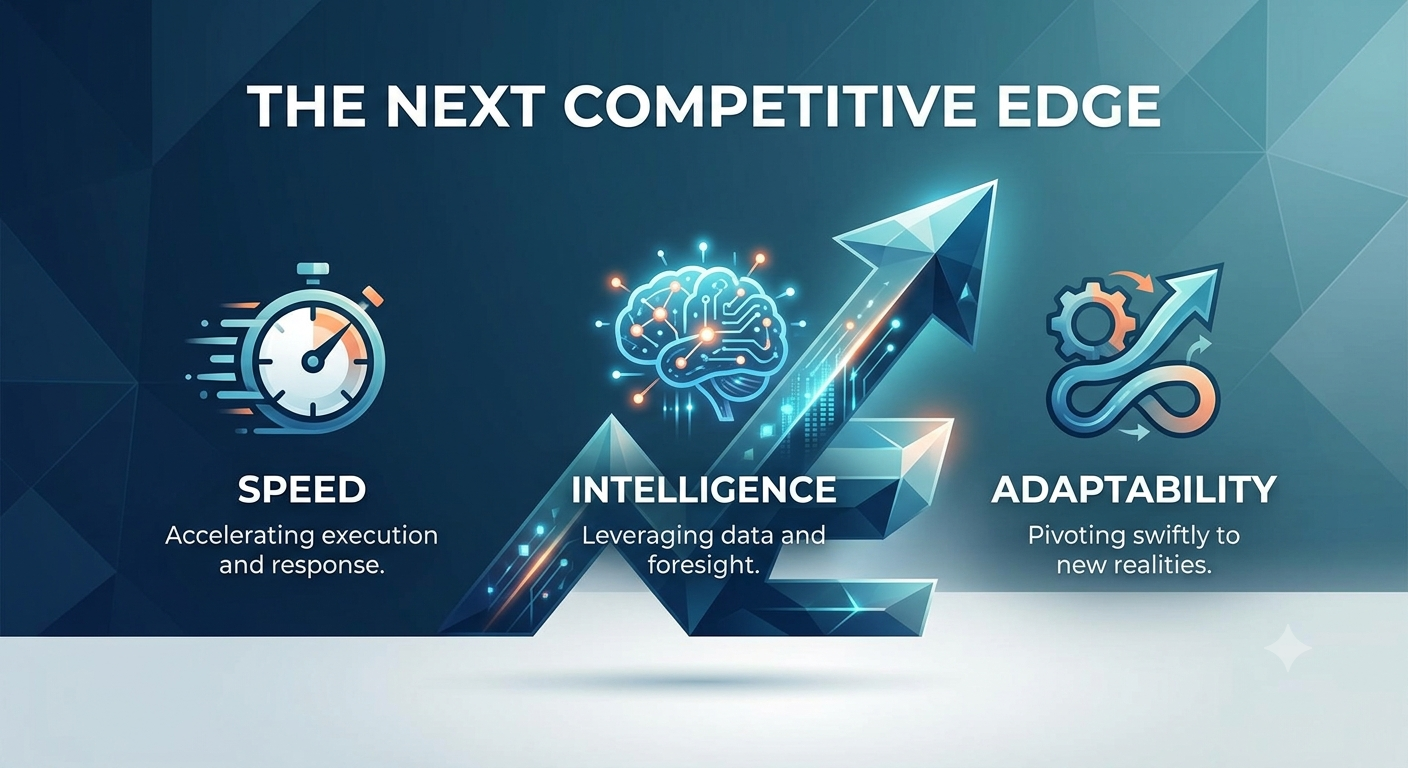
As a result, organizations are discovering that Competitive Advantage is no longer determined solely by resources or size. Instead, success increasingly depends on how effectively businesses can respond to change, make informed decisions, and continuously evolve. This shift has given rise to a new formula for business success: speed, intelligence, and adaptability.
The New Drivers of Competitive Advantage
Modern markets are characterized by constant disruption. Customer preferences evolve rapidly, technologies mature quickly, and new competitors can enter markets with fewer barriers than ever before. In such an environment, organizations must develop capabilities that allow them to move confidently through uncertainty.
The next generation of Competitive Advantage is built on three interconnected capabilities:
| Capability | Business Impact |
|---|---|
| Speed | Accelerates decision-making and execution |
| Intelligence | Improves decision quality through data-driven insights |
| Adaptability | Enables organizations to remain effective during change |
Together, these capabilities create organizations that can identify opportunities earlier, respond faster, and maintain performance despite evolving conditions.
Speed: Reducing the Distance Between Insight and Action
Business speed is often misunderstood. It does not simply mean working faster or creating pressure within teams. Instead, speed refers to reducing the gap between identifying an opportunity and taking action.
Historically, organizations relied on multiple layers of approvals, lengthy reporting structures, and sequential decision-making processes. While these systems provided control, they also introduced delays. In today’s fast-moving markets, delays can lead to missed opportunities and declining customer satisfaction.
Organizations seeking Competitive Advantage are investing in automation, real-time analytics, intelligent workflows, and connected platforms to eliminate friction from operations. These technologies help teams make decisions faster while maintaining quality and consistency.
Customers now expect immediate responses, personalized experiences, and seamless interactions. Businesses that can deliver these experiences efficiently gain a significant advantage over slower competitors.
Intelligence: Transforming Data into Actionable Insights
While speed enables action, intelligence ensures that actions are effective. Modern businesses generate enormous amounts of data through customer interactions, operational processes, financial systems, and market activities. The challenge is no longer collecting information but transforming it into meaningful insights.
Business intelligence involves identifying patterns, understanding trends, and making informed decisions that improve outcomes. Artificial intelligence, predictive analytics, machine learning, and cloud-based technologies are helping organizations shift from reactive decision-making to proactive planning.
Organizations that use intelligence effectively strengthen their Competitive Advantage by anticipating market changes before they occur. Rather than responding after disruptions happen, these businesses identify signals early and take strategic action.
However, intelligence creates value only when organizations are willing to act on insights. Companies that balance analysis with execution are often the ones that outperform competitors.
Adaptability: Thriving in a Changing Environment
Adaptability is becoming one of the most critical business capabilities. Unlike flexibility, which often implies temporary adjustments, adaptability is the ability to remain effective while conditions continuously evolve.
Traditional business models were built around consistency and predictability. Today, change has become a permanent feature of the business landscape. Customer expectations shift rapidly, workforce models evolve, and technology continues to transform how organizations operate.
Companies that develop adaptability create a sustainable Competitive Advantage because they can adjust without losing strategic focus. Adaptable organizations encourage continuous learning, empower employees to innovate, and build systems capable of evolving alongside market conditions.
This capability extends across every business function. Sales teams must adapt to changing buyer behavior, marketing teams must respond to new digital channels, HR departments must support evolving workforce expectations, and technology leaders must balance innovation with operational resilience.
Why Speed, Intelligence, and Adaptability Work Together
The most successful organizations recognize that these capabilities are interconnected. Speed without intelligence can lead to poor decisions. Intelligence without adaptability can slow execution. Adaptability without speed may prevent organizations from creating meaningful impact.
Businesses that align all three capabilities create a stronger and more sustainable Competitive Advantage. They can respond quickly, make smarter decisions, and maintain effectiveness even when market conditions change unexpectedly.
This combination is becoming especially important in B2B environments where buyers expect personalized experiences, faster responses, and ongoing value. Organizations that can meet these expectations consistently are more likely to build long-term customer relationships and achieve sustainable growth.
Building Competitive Advantage for the Future
Looking ahead, the organizations that succeed may not necessarily be the largest or most established. Instead, they are likely to be the fastest learners and the most adaptive decision-makers.
Technology will continue to create opportunities, but execution will determine success. Businesses that simplify processes, empower teams, embrace data-driven decision-making, and foster innovation will strengthen their Competitive Advantage in an increasingly uncertain world.
Conclusion
The future of Competitive Advantage will not be defined solely by larger budgets, bigger teams, or longer market presence. Instead, it will be built on the ability to move quickly without sacrificing quality, make intelligent decisions without creating unnecessary complexity, and adapt continuously without losing strategic direction.
Speed, intelligence, and adaptability are no longer optional business capabilities. They have become essential pillars of resilience, innovation, and sustainable growth. Organizations that invest in these strengths today will be better positioned not only to compete in the future but to help shape it.