
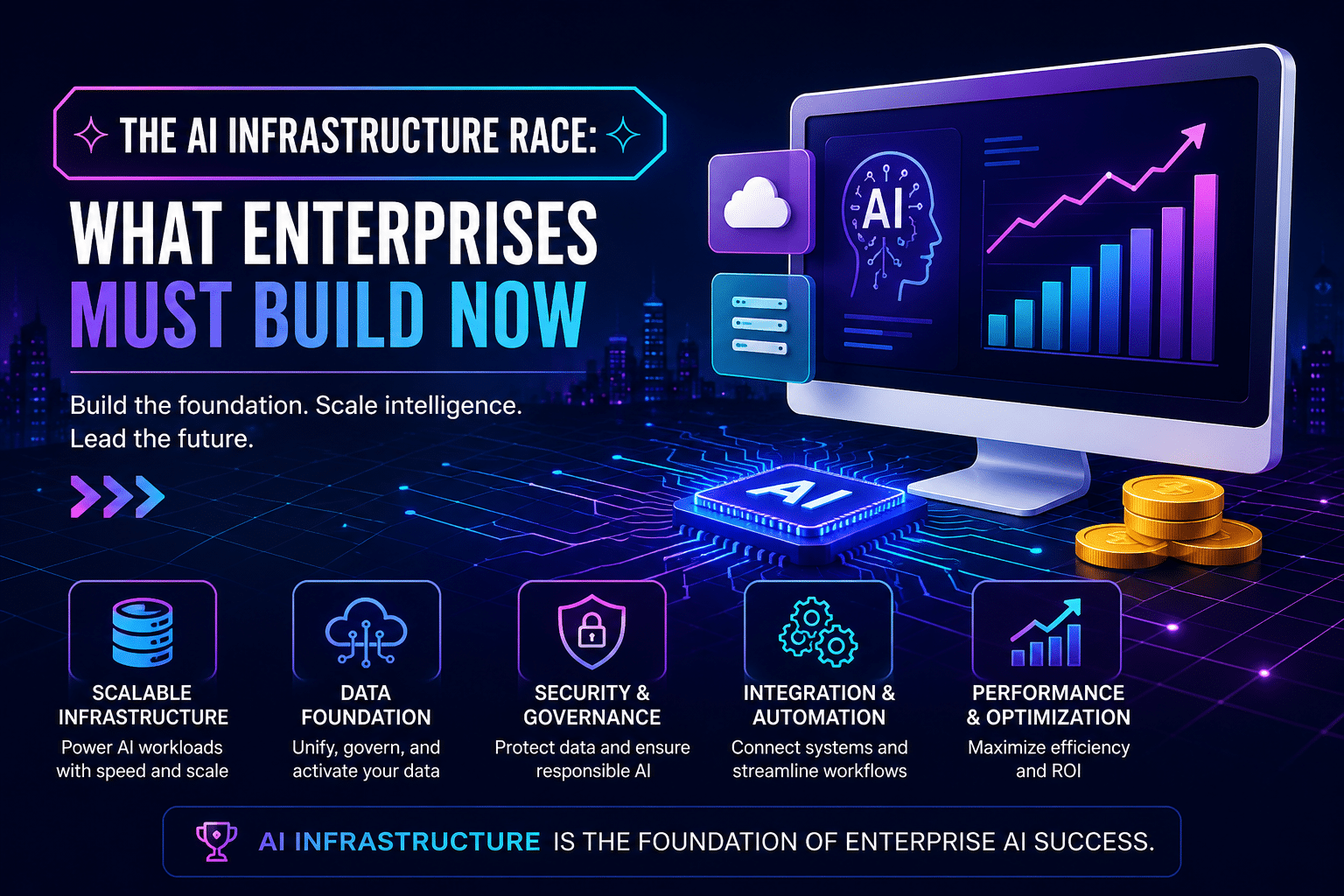
AI Infrastructure has become the foundation of successful enterprise artificial intelligence initiatives. As AI moves beyond experimentation and into large-scale business operations, organizations are discovering that advanced algorithms alone are not enough. The ability to scale AI depends on robust infrastructure that supports high-performance computing, unified data management, seamless integration, security, and governance. Over the past few years, enterprises across industries have invested heavily in AI projects, yet many continue to struggle with achieving measurable business outcomes. The challenge is no longer whether AI delivers value—it is whether organizations have built the infrastructure needed to unlock that value at scale. As AI becomes a core driver of innovation and competitive advantage, enterprises are entering a new race: not simply to adopt AI, but to build the operational foundation that enables intelligent, scalable, and sustainable growth.
Historically, technology infrastructure was designed around stability, efficiency, and predictable workloads. Enterprise systems were optimized to support structured processes, controlled access, and incremental change. AI introduces fundamentally different requirements. Modern AI systems rely on continuous data movement, intensive computation, rapid experimentation, real-time processing, and dynamic decision-making. Infrastructure that once supported digital operations is increasingly insufficient for intelligent operations. Organizations are realizing that successful AI implementation depends less on algorithms themselves and more on the environment surrounding them.
At the centre of this transformation is computing architecture. AI workloads demand environments capable of processing enormous volumes of information while maintaining speed and scalability. Traditional infrastructure approaches often struggle to support training, inference, and continuous model improvement at enterprise scale. As a result, businesses are redesigning infrastructure around elasticity, distributed processing, high-performance environments, and workload flexibility. Cloud environments, hybrid ecosystems, and intelligent orchestration layers are becoming essential components of enterprise readiness. Infrastructure is evolving from a support function into a strategic business capability.
Data infrastructure is becoming equally critical because AI performance directly reflects the quality of information it receives. Many enterprises discovered that their biggest obstacle to AI was not technology availability but fragmented data environments. Information remains scattered across departments, trapped inside legacy systems, duplicated across platforms, and governed inconsistently. Without unified and accessible data foundations, AI systems generate limited value regardless of model sophistication. This has created renewed emphasis on enterprise data architectures that prioritize accessibility, quality, governance, interoperability, and contextual understanding.
However, building AI-ready data environments goes beyond centralization. Organizations increasingly require architectures capable of supporting both historical and real-time intelligence. Customer interactions, operational signals, behavioural inputs, transaction activity, and external market indicators must flow continuously into environments where insights can be generated instantly. Enterprises are shifting from static reporting structures toward adaptive intelligence ecosystems where decisions become increasingly data-driven and automated.
Another major pillar of AI infrastructure is integration. One of the most common reasons AI initiatives fail is that intelligent capabilities remain disconnected from everyday workflows. Enterprises may develop strong models but struggle to operationalize outputs across business functions. To solve this, organizations are investing in orchestration layers that connect intelligence with customer systems, internal applications, communication platforms, operational tools, and decision environments. The goal is not simply to generate insights but to embed intelligence directly into how work gets done.
The growing interest in agentic systems and autonomous workflows is accelerating this requirement further. Enterprises are beginning to move beyond AI as a recommendation engine and toward AI as an active participant in execution. Intelligent systems are increasingly capable of managing workflows, coordinating tasks, generating outputs, monitoring outcomes, and supporting operational decisions with minimal intervention. This transition requires infrastructure designed not only for intelligence but also for reliability, observability, governance, and controlled autonomy.
Security and governance are emerging as defining factors in the AI infrastructure race. As intelligent systems gain access to more business-critical information and influence increasingly important decisions, enterprises must establish stronger control mechanisms. Infrastructure strategies now include responsible AI policies, model oversight frameworks, identity controls, compliance mechanisms, audit capabilities, and resilience planning. Organizations are recognizing that trust is not a by-product of AI adoption, it is an architectural decision that must be designed from the beginning.
Talent and operating models are also becoming infrastructure challenges rather than human resource concerns alone. Building intelligent enterprises requires new forms of collaboration across engineering, analytics, business leadership, security, and operations teams. Traditional organizational structures often create barriers that slow AI deployment and limit impact. Successful enterprises are redesigning governance models, encouraging cross-functional ownership, and building capabilities that allow experimentation without sacrificing scalability.
Cost optimization has become another major differentiator. Early AI adoption created a mind-set that more infrastructure automatically produced better outcomes. Enterprises are now discovering that intelligent scale requires disciplined architecture decisions. Efficient resource allocation, model selection strategies, workload prioritization, and infrastructure observability are becoming essential to maintaining long-term value. Competitive advantage increasingly comes from deploying intelligence efficiently rather than simply deploying more of it.
Perhaps the most important shift taking place is philosophical. Infrastructure is no longer viewed as an invisible layer that supports innovation happening elsewhere. It is becoming the environment where innovation itself occurs. Businesses that continue treating infrastructure as a technical expense risk limiting their ability to compete in increasingly intelligent markets. Those that invest strategically in AI-ready foundations create conditions where innovation becomes repeatable, scalable, and sustainable.
The AI infrastructure race is not about acquiring the newest tools or announcing the largest transformation programs. It is about building systems that allow intelligence to operate continuously across the enterprise. The organizations that win this race will not necessarily be those that launch the most AI initiatives, but those that create the strongest foundations for intelligence to grow over time. In the coming years, enterprise leaders will likely discover that infrastructure decisions are no longer technology decisions alone, they are business decisions that determine speed, resilience, adaptability, and future growth.
AI is becoming the next operating layer of business, and infrastructure is becoming the engine behind it. Enterprises that build deliberately today will define the competitive landscape of tomorrow.
AI Infrastructure is no longer an optional investment—it is the foundation of enterprise innovation. Organizations that prioritize AI Infrastructure today will be better positioned to scale artificial intelligence, improve operational efficiency, strengthen security, and drive sustainable business growth in the years ahead.