
Understanding the Shift in Modern Sales-
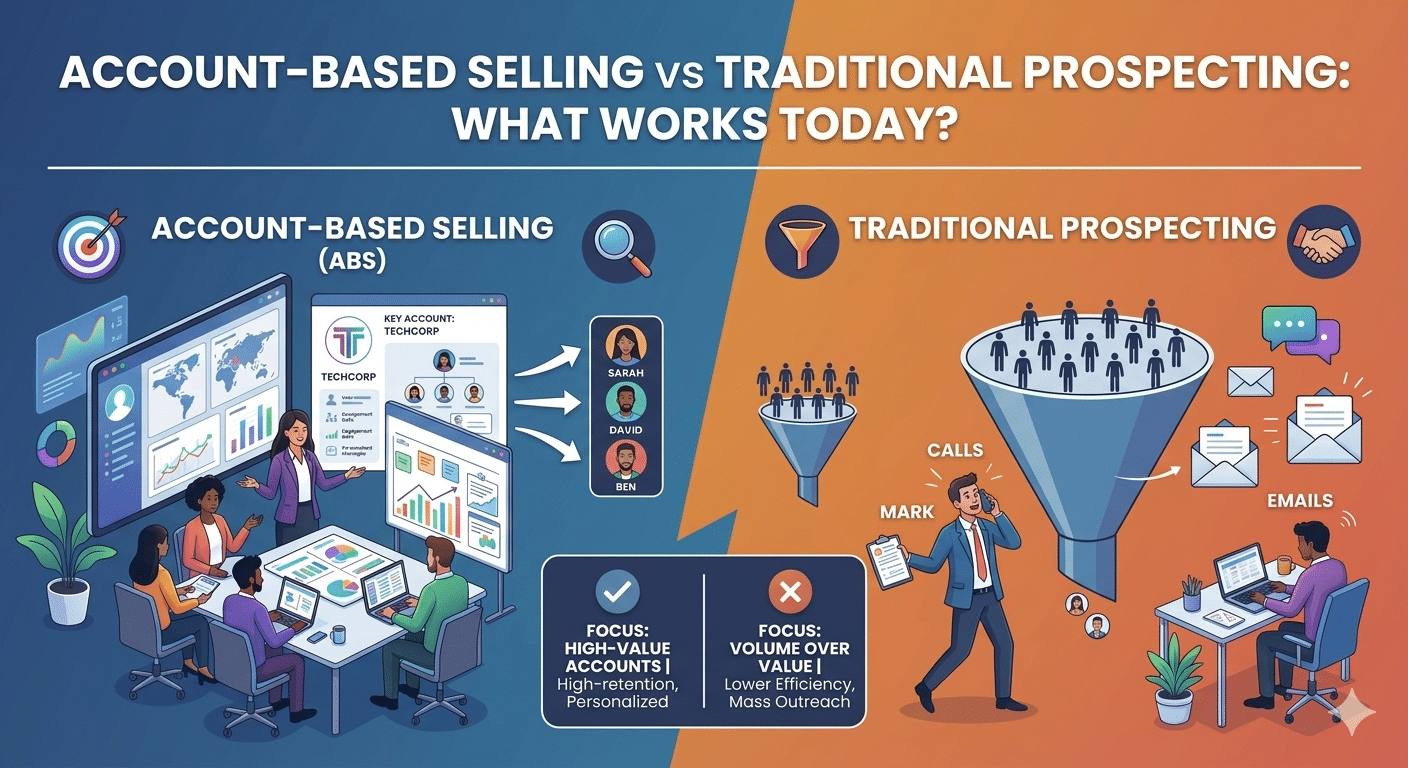
The sales environment has evolved significantly as buyers now have access to more information than ever before. Traditional prospecting, which relies on reaching a large number of potential customers through cold calls, emails, and networking, has been a cornerstone of sales for decades. However, Account-Based Selling (ABS) has emerged as a more focused strategy that targets specific high-value accounts. Businesses are increasingly evaluating which approach delivers better results in today’s competitive market. The answer often depends on factors such as deal size, customer value, and industry requirements. While traditional prospecting emphasizes volume, ABS prioritizes quality and personalization. Understanding the strengths and limitations of both methods is essential for building a successful sales strategy.
Key Highlights:
- Traditional prospecting focuses on reaching a broad audience.
- Account-Based Selling targets selected high-value accounts.
- Buyer behavior has changed significantly in recent years.
- Personalization is becoming a critical sales factor.
- Both methods serve different business objectives.
Traditional Prospecting: The Power of Scale-
Traditional prospecting remains a popular approach because it allows sales teams to generate a large number of leads within a relatively short period. Sales representatives can contact hundreds of prospects through cold calling, email campaigns, social media outreach, and referrals. This method works particularly well for businesses with shorter sales cycles and products designed for a broad market. The primary advantage is scalability, as companies can continuously fill their sales pipeline with new opportunities. However, response rates have declined due to increased competition and buyer fatigue. Many prospects ignore generic sales messages because they receive similar communications daily. Despite these challenges, organizations that optimize their outreach and follow-up processes can still achieve strong results through traditional prospecting.
Benefits of Traditional Prospecting:
- Generates leads quickly.
- Supports high-volume sales models.
- Requires lower initial investment.
- Works well for startups and growing businesses.
- Helps build a consistent sales pipeline.
Account-Based Selling: Focusing on High-Value Opportunities-
Account-Based Selling takes a different approach by concentrating efforts on a carefully selected group of target accounts. Instead of trying to reach as many prospects as possible, ABS focuses on organizations that have the highest potential value for the business. Sales and marketing teams work together to understand the target account’s challenges, goals, and decision-makers. This enables highly personalized communication that resonates with stakeholders. Because enterprise purchases often involve multiple decision-makers, ABS helps companies engage everyone involved in the buying process. Although the strategy requires more research and resources, it often leads to higher conversion rates and larger deal sizes. As competition grows, many organizations are turning to ABS to strengthen customer relationships and improve revenue outcomes.
Advantages of Account-Based Selling:
- Delivers highly personalized outreach.
- Increases engagement with decision-makers.
- Improves win rates on strategic deals.
- Creates stronger long-term relationships.
- Generates higher customer lifetime value.
Which Approach Performs Better in Today’s Market?
There is no single sales strategy that works for every organization. Traditional prospecting is highly effective for businesses that need a steady flow of leads and operate in markets with shorter buying cycles. On the other hand, Account-Based Selling excels when targeting large organizations with complex purchasing processes. Today’s buyers expect relevant communication and solutions tailored to their needs, making personalization more important than ever. Companies that rely solely on mass outreach may struggle to stand out in crowded markets. Meanwhile, organizations that focus only on ABS may limit their ability to generate new opportunities at scale. The most successful sales teams recognize that both approaches have value and should be applied based on business goals and customer profiles.
Factors to Consider:
- Average deal size.
- Length of the sales cycle.
- Available sales resources.
- Customer acquisition costs.
- Target market complexity.
The Rise of the Hybrid Sales Model-
Modern sales leaders are increasingly combining traditional prospecting with Account-Based Selling to maximize results. This hybrid approach uses broad outreach to identify potential opportunities while applying account-based techniques to high-value prospects. Sales teams can leverage data, customer insights, and artificial intelligence to determine which accounts deserve personalized attention. By balancing volume with precision, organizations can build larger pipelines without sacrificing engagement quality. This strategy also allows businesses to adapt quickly to changing market conditions and buyer expectations. As technology continues to transform sales processes, hybrid models are becoming the preferred choice for companies seeking sustainable growth and stronger customer relationships. The ability to integrate both methods effectively often determines long-term sales success.
Why Hybrid Sales Works:
- Combines scale and personalization.
- Improves resource allocation.
- Enhances customer engagement.
- Supports revenue growth.
- Increases overall sales efficiency.
Future Outlook: What Sales Teams Should Expect Next-
The future of sales will be heavily influenced by technology, data analytics, and changing customer expectations. Buyers are becoming more informed before engaging with sales representatives, making it essential for businesses to provide value from the very first interaction. Artificial intelligence, predictive analytics, and automation tools are helping sales teams identify the right prospects and personalize outreach more effectively. As organizations continue to invest in digital transformation, both Account-Based Selling and Traditional Prospecting will evolve. Sales professionals who can adapt to these changes and leverage modern tools will have a significant advantage in the marketplace. The focus will increasingly shift from simply selling products to building meaningful customer relationships and delivering measurable business outcomes.
Emerging Sales Trends:
- Increased use of AI-driven sales tools.
- Greater focus on customer experience.
- More data-driven decision-making.
- Expansion of sales automation.
- Growing demand for personalized engagement.
Building a Sales Strategy That Delivers Results-
Choosing the right sales approach requires a clear understanding of business objectives and customer needs. Organizations should analyze their target market, average deal size, and available resources before deciding how to allocate sales efforts. Businesses targeting enterprise clients may benefit more from Account-Based Selling, while those operating in high-volume markets may find traditional prospecting more effective. However, combining both approaches often creates the strongest foundation for growth. Regular performance analysis and continuous optimization are also critical for long-term success. By monitoring key metrics and adapting strategies based on results, companies can ensure their sales processes remain efficient and competitive.
Conclusion-
Account-Based Selling and Traditional Prospecting each offer unique advantages in today’s sales landscape. Traditional prospecting remains valuable for generating leads and maintaining a healthy pipeline, while Account-Based Selling provides deeper engagement and stronger opportunities with high-value accounts. Rather than choosing one strategy over the other, businesses should evaluate their goals, target audience, and available resources to determine the right balance. In an era where buyers expect personalized experiences, combining the reach of traditional prospecting with the precision of Account-Based Selling often delivers the best results.