
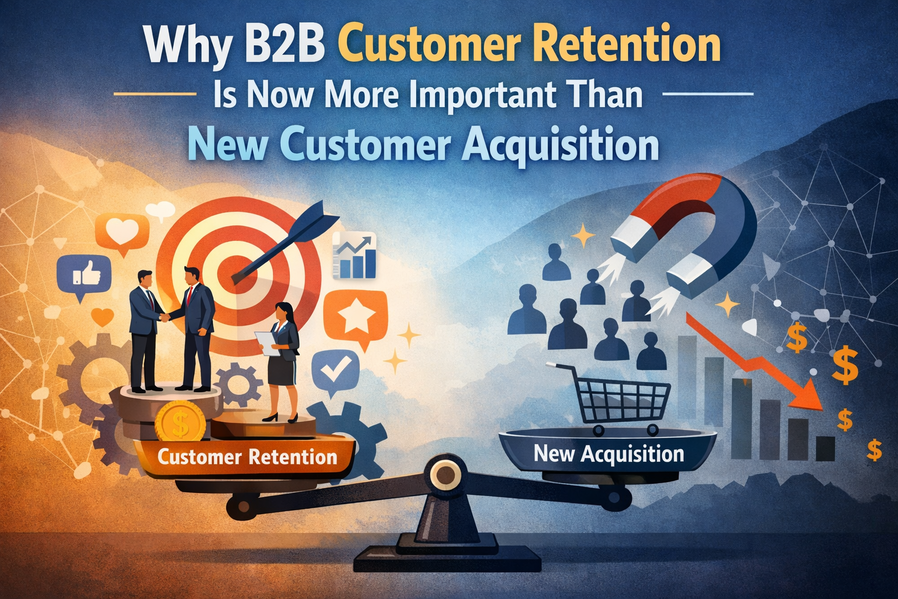
In B2B markets, growth strategies have long been dominated by one goal: acquiring new customers. Sales funnels, lead-generation campaigns, and outbound outreach have traditionally received the largest share of budgets and attention. But the reality of today’s B2B environment is forcing a major shift in priorities. Rising acquisition costs, longer sales cycles, intense competition, and increasingly informed buyers have made customer retention not just a support function—but a core growth strategy.
B2B organizations that focus on keeping, expanding, and deepening relationships with existing customers are outperforming those that rely primarily on net-new acquisition. Retention is no longer a defensive tactic; it is a strategic advantage.
The Rising Cost and Complexity of B2B Acquisition –
Customer acquisition has become significantly more expensive and unpredictable than it was even a few years ago. Digital advertising costs continue to rise, organic reach is declining, and decision-makers are harder to access. In B2B, buying committees are larger, sales cycles are longer, and trust takes more time to build.
Additionally, most buyers complete a substantial portion of their research before ever speaking with a sales representative. By the time a prospect engages, they already have expectations shaped by competitors, peer reviews, and analyst reports. This means sales teams must invest more time and resources just to stay competitive—often with no guarantee of conversion.
Retention, by contrast, builds on relationships that already exist. The trust is established, the onboarding costs are sunk, and the customer understands the product’s value. From an efficiency standpoint alone, retention delivers a far stronger return on investment.
Existing Customers Drive Higher Lifetime Value –
In B2B, revenue is rarely transactional. Contracts renew annually, subscriptions expand, and customers often purchase multiple solutions over time. Retained customers generate predictable, recurring revenue and typically increase their value as the relationship matures.
Long-term customers are more likely to:
- Upgrade to higher-tier plans
- Purchase complementary products or services
- Commit to longer contracts
- Accept price adjustments with less resistance
This compounding effect significantly increases customer lifetime value (CLV). When retention is strong, each customer becomes a growth asset rather than a one-time win.
Retention Fuels Expansion and Upsell Opportunities –
New customer acquisition focuses on winning logos. Retention focuses on growing accounts. In many B2B organizations, a substantial portion of revenue growth comes from existing customers through upsells, cross-sells, and renewals.
Because existing customers already understand the product, expansion conversations are faster and more consultative. Sales and account teams can position new features or services as solutions to real, observed challenges rather than hypothetical ones.
This makes retention-driven growth more scalable and more resilient, especially during economic uncertainty when new spending is closely scrutinized.
Trust and Relationships Are Core to B2B Buying –
B2B purchasing decisions are high-stakes. They impact operations, revenue, security, and reputations. As a result, buyers strongly prefer vendors they trust.
Retention is a direct outcome of trust built over time through:
- Consistent product performance
- Reliable support and service
- Transparent communication
- Demonstrated understanding of customer needs
Satisfied customers are not only more likely to stay—they become advocates. Referrals, testimonials, and case studies from existing clients carry far more credibility than any marketing campaign. In this way, retention indirectly supports acquisition by strengthening brand reputation and social proof.
Retention Improves Forecasting and Business Stability –
Predictable revenue is critical in B2B, especially for SaaS and subscription-based models. High retention rates stabilize cash flow and improve forecasting accuracy, enabling better investment decisions across product development, hiring, and marketing.
When churn is high, companies are forced into a constant cycle of replacing lost revenue. This “leaky bucket” problem makes growth fragile and reactive. Strong retention, on the other hand, creates a solid revenue base that allows acquisition efforts to be more selective and strategic.
Customer Expectations Have Changed –
Today’s B2B customers expect more than a functional product. They expect ongoing value, proactive support, and personalized engagement throughout the customer lifecycle.
Retention strategies now require collaboration across departments:
- Product teams must continuously improve usability and relevance
- Customer success teams must anticipate risks and guide adoption
- Marketing teams must deliver value beyond the initial sale
- Sales teams must transition from closers to long-term advisors
Companies that fail to meet these expectations risk churn—not because the product is inadequate, but because the experience is.
Technology Is Making Retention Measurable and Actionable –
Modern B2B organizations have access to powerful tools that make retention a data-driven discipline. Customer Data Platforms (CDPs), CRM systems, analytics tools, and AI-driven insights allow teams to:
- Monitor usage and engagement patterns
- Identify churn risks early
- Personalize communication at scale
- Measure retention, expansion, and satisfaction in real time
This visibility enables proactive retention strategies rather than reactive damage control. Companies can intervene before dissatisfaction turns into churn.
Retention and Acquisition Are No Longer Opposites –
Prioritizing retention does not mean abandoning acquisition. Instead, it means rebalancing focus. The most successful B2B companies view acquisition and retention as interconnected.
A strong retention foundation:
- Improves win rates for new deals through credibility
- Reduces pressure on sales to overpromise
- Creates reference customers for new markets
In this model, retention becomes the engine that makes acquisition more efficient and sustainable.
Conclusion –
In today’s competitive B2B landscape, growth is no longer defined by how many customers you acquire, but by how many you keep—and how well you grow them over time. Customer retention delivers higher lifetime value, predictable revenue, stronger relationships, and long-term stability.
As acquisition costs rise and buyer expectations evolve, retention has moved from a secondary metric to a strategic imperative. B2B organizations that invest in customer experience, success, and long-term value creation will not only retain customers—they will build durable, scalable growth.