
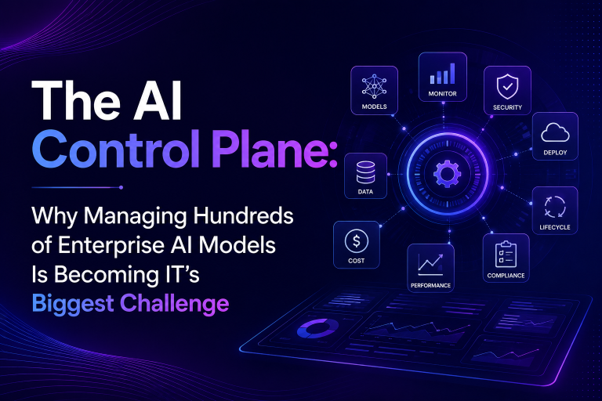
AI Control Plane has rapidly become one of the most important concepts in enterprise artificial intelligence as organizations shift their focus from simply building AI models to managing them at scale. Over the past few years, enterprise conversations around artificial intelligence have primarily focused on building, deploying, and adopting AI models. Organizations invested heavily in large language models, machine learning platforms, generative AI assistants, computer vision systems, predictive analytics, and intelligent automation to improve productivity and accelerate digital transformation. Initially, these deployments were limited to isolated use cases within individual departments.
Marketing teams implemented AI for content generation, sales organizations adopted conversational intelligence, HR introduced recruitment automation, finance leveraged predictive forecasting, while IT experimented with AI-powered software development and cybersecurity operations. However, enterprise AI has now reached a stage where organizations are no longer managing a handful of AI applications—they are operating hundreds of models across business functions, cloud environments, software platforms, and geographical regions.
This rapid expansion has created a new operational challenge that many enterprises did not anticipate. The competitive advantage no longer lies solely in building better AI models but in managing them efficiently, securely, and consistently at scale. This emerging discipline has given rise to what technology leaders increasingly describe as the AI Control Plane, a centralized operational layer designed to govern, monitor, orchestrate, and optimize enterprise AI ecosystems.
The concept of a control plane is not new within enterprise technology. Cloud computing platforms rely on control planes to coordinate infrastructure resources, software-defined networks use control planes to manage traffic routing, and Kubernetes transformed application deployment by separating operational management from workload execution. Artificial intelligence is now following a similar evolution.
Instead of treating every AI model as an independent application, organizations are beginning to view AI as a distributed enterprise resource requiring centralized governance. An AI Control Plane provides a unified operational framework where IT teams can oversee model deployment, monitor performance, enforce security policies, allocate computing resources, control costs, manage model lifecycles, ensure regulatory compliance, and coordinate interactions between multiple AI systems. Without such an operational layer, enterprises risk creating fragmented AI environments that become increasingly difficult to secure, maintain, and scale.
One of the primary drivers behind the emergence of AI Control Planes is the extraordinary diversity of modern enterprise AI environments. Very few organizations rely on a single model or technology provider. Instead, enterprises often combine proprietary large language models, open-source foundation models, industry-specific machine learning algorithms, internally trained predictive systems, cloud-based AI services, and specialized AI applications integrated into existing enterprise software. Different departments frequently select different AI platforms based on their immediate business needs, resulting in a highly fragmented ecosystem.
Marketing may use one model for content creation, customer service another for virtual assistance, finance a different platform for forecasting, and software engineering multiple coding assistants. Without centralized oversight, IT departments struggle to maintain visibility into which models are being used, how they interact with enterprise data, what permissions they possess, and whether they comply with organizational governance standards. The AI Control Plane provides a consolidated view that transforms disconnected AI initiatives into a coordinated enterprise capability.
Security has become one of the strongest arguments for centralized AI governance. Every AI model introduced into an enterprise environment potentially gains access to sensitive information, including customer records, financial reports, intellectual property, employee data, product documentation, software code, legal agreements, and strategic business plans. As organizations deploy dozens or even hundreds of AI-powered applications, ensuring consistent access controls becomes increasingly complex.
An AI Control Plane enables IT teams to establish centralized authentication, role-based permissions, encryption policies, audit logging, and data access controls across every deployed model. Instead of individually configuring security settings for each AI application, organizations implement enterprise-wide governance policies that reduce vulnerabilities while maintaining operational consistency. This centralized approach is particularly important as regulatory expectations surrounding AI accountability continue to evolve across global markets.
Another critical function of the AI Control Plane is model orchestration. Enterprise AI increasingly depends on multiple models working together rather than isolated systems operating independently. A customer service interaction, for example, may involve a conversational language model, a sentiment analysis engine, a recommendation algorithm, a document retrieval system, a fraud detection model, and a workflow automation platform, all collaborating to resolve a single customer request. Coordinating these interactions manually quickly becomes impractical as AI deployments expand.
The control plane manages communication between models, routes requests to the most appropriate system, balances computational workloads, optimizes response times, and ensures that complex AI workflows operate reliably across enterprise infrastructure. This orchestration capability allows organizations to build sophisticated AI ecosystems while minimizing operational complexity.
Cost management is emerging as another major challenge addressed by AI Control Planes. Running advanced AI models requires significant computational resources, particularly when organizations rely on cloud-based inference, GPU clusters, and multiple commercial AI services. As adoption accelerates, AI spending can increase rapidly without centralized visibility into resource consumption. Different departments may unknowingly duplicate models, overprovision infrastructure, or execute expensive workloads that generate limited business value.
The AI Control Plane continuously monitors usage patterns, allocates computing resources dynamically, identifies redundant deployments, optimizes inference routing, and provides executives with comprehensive cost intelligence. Rather than viewing AI expenditure as a collection of disconnected software subscriptions, organizations gain the ability to manage AI investments strategically while maximizing return on technology spending.
Model lifecycle management represents another essential capability within enterprise AI governance. Artificial intelligence systems are not static technologies that remain effective indefinitely after deployment. Models require continuous updates, retraining, testing, validation, version control, and retirement as business requirements evolve and new technologies emerge. Performance may decline because of changing customer behaviour, shifting market conditions, outdated training data, or evolving regulatory requirements.
The AI Control Plane enables IT teams to monitor model performance throughout its operational lifecycle, detect degradation, coordinate updates, manage multiple versions simultaneously, and automate deployment pipelines while maintaining business continuity. This operational discipline ensures that enterprise AI remains accurate, reliable, and aligned with organizational objectives over time.
Observability has become equally important as organizations depend on AI for mission-critical decision-making. Traditional application monitoring focuses on metrics such as uptime, latency, and system availability. AI introduces entirely new operational challenges, including hallucinations, confidence scores, model drift, bias detection, inference quality, response consistency, token consumption, and reasoning accuracy.
Without comprehensive observability, organizations may struggle to identify when AI systems begin producing unreliable or inconsistent outputs. The AI Control Plane continuously measures these operational characteristics, allowing IT teams to detect anomalies before they significantly affect business processes. This proactive monitoring transforms AI management from reactive troubleshooting into continuous operational optimization.
Compliance and governance requirements are also driving investment in AI Control Planes. Governments and regulatory authorities worldwide are introducing new frameworks governing AI transparency, accountability, explaining ability, data privacy, and risk management. Enterprises operating across multiple industries and jurisdictions must demonstrate that AI systems comply with evolving legal standards while maintaining detailed records regarding model usage, decision-making processes, data sources, and operational controls.
A centralized AI Control Plane simplifies regulatory compliance by maintaining comprehensive audit trails, documenting model behaviour, enforcing governance policies, and generating reports required for internal oversight or external review. Instead of managing compliance separately for every AI application, organizations establish standardized governance processes that scale alongside enterprise AI adoption.
The rise of multi-agent AI systems further reinforces the importance of centralized operational management. Rather than relying on a single language model, enterprises are increasingly deploying networks of specialized AI agents responsible for planning, research, analytics, software development, procurement, customer engagement, workflow automation, and strategic decision support. These agents collaborate, exchange information, delegate responsibilities, and complete complex business processes with minimal human intervention.
Coordinating hundreds of autonomous agents requires far more sophisticated management than traditional software administration. The AI Control Plane provides centralized supervision over agent interactions, resource allocation, communication protocols, execution priorities, and operational boundaries, ensuring that autonomous systems function collaboratively without compromising organizational security or governance.
Vendor management is becoming another strategic consideration as enterprises diversify their AI ecosystems. Organizations rarely depend exclusively on one AI provider. Instead, they combine multiple commercial models, open-source technologies, internally developed solutions, and specialized industry platforms to meet varying business requirements. This multi-vendor environment offers flexibility but significantly increases operational complexity. An AI Control Plane abstracts many of these differences by providing standardized interfaces, unified governance policies, centralized monitoring, and consistent operational procedures regardless of the underlying AI provider. This architectural flexibility reduces vendor lock-in while enabling enterprises to adopt emerging technologies without disrupting existing operations.
The integration of AI Control Planes with broader enterprise technology infrastructure is equally significant. Modern IT environments already include cloud management platforms, cybersecurity operations, identity management systems, enterprise architecture frameworks, observability platforms, DevOps pipelines, and business intelligence tools. Rather than operating independently, AI governance increasingly becomes part of this larger operational ecosystem. The control plane acts as a coordination layer that connects artificial intelligence with enterprise infrastructure, ensuring that AI initiatives align with broader business objectives while maintaining consistency across technology operations. This integration transforms AI from an isolated innovation initiative into a fully governed enterprise capability.
Despite its strategic importance, implementing an AI Control Plane presents organizational as well as technical challenges. Enterprises must establish clear governance frameworks, define ownership responsibilities, standardize AI deployment processes, develop operational policies, invest in workforce capabilities, and ensure collaboration between IT, cybersecurity, legal, compliance, data science, and business leadership teams. AI governance cannot remain solely the responsibility of technical specialists because the implications of AI decisions increasingly extend into every aspect of enterprise operations. Successful organizations recognize that the AI Control Plane is not merely a technology platform but an operating model that combines intelligent automation with responsible governance and strategic oversight.
Looking ahead, the AI Control Plane is likely to become one of the defining architectural components of the modern digital enterprise. Just as cloud management platforms became essential for managing distributed infrastructure and cybersecurity operations evolved into centralized security ecosystems, AI governance is rapidly becoming an enterprise-wide operational discipline. Organizations will continue deploying increasingly diverse AI models, autonomous agents, intelligent workflows, and decision-support systems, making centralized management indispensable rather than optional.
Competitive advantage will increasingly depend not only on how effectively enterprises build AI solutions but also on how intelligently they manage them at scale. The future of enterprise IT will not be defined by the number of AI models an organization deploys but by its ability to govern those models with security, efficiency, transparency, and resilience. In that future, the AI Control Plane will serve as the operational foundation that enables artificial intelligence to evolve from isolated innovation into trusted enterprise infrastructure capable of supporting long-term business transformation.