
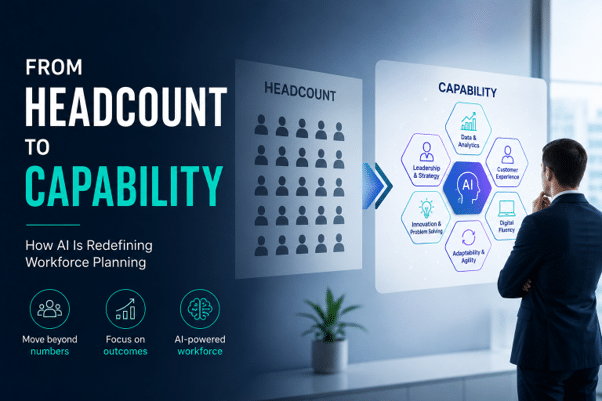
AI workforce planning is transforming the way organizations think about growth, talent, and long-term business success. For decades, workforce planning was driven by a simple assumption: as businesses expanded, they needed to hire more people. Organizational strength was often measured by headcount, hiring targets, and the size of individual departments. Today, artificial intelligence is challenging that traditional model by shifting the focus from the number of employees to the capabilities that drive business outcomes.
Rather than viewing work as a collection of fixed job roles, organizations are beginning to see it as a combination of individual tasks, specialized skills, and business capabilities. AI makes it possible to automate repetitive activities, augment knowledge-based work, and streamline complex workflows. This allows businesses to rethink how work is organized and delivered. Instead of asking, “How many employees do we need?” leaders are increasingly asking, “What capabilities are required to achieve our strategic goals?”
As organizations embrace AI Workforce Planning, they are shifting away from traditional hiring models and adopting strategies that prioritize business capabilities, workforce agility, and digital transformation.
This transition represents one of the most significant changes in modern workforce planning. AI enables organizations to redesign work around outcomes instead of positions. Routine administrative tasks, data processing, reporting, scheduling, and content generation can often be handled by AI-powered tools, while employees focus on responsibilities that require creativity, critical thinking, emotional intelligence, collaboration, and strategic decision-making. As a result, workforce capacity is no longer determined solely by hiring additional staff but by combining human expertise with intelligent technology.
The shift toward capability-based workforce planning also changes how organizations respond to business growth. In the past, increasing customer demand often meant expanding teams through recruitment. Today, businesses have more options available. They can automate repetitive processes, reskill existing employees, encourage internal mobility, redesign workflows, or selectively hire for specialized expertise. AI provides organizations with the flexibility to increase productivity without relying exclusively on workforce expansion, creating a more agile and efficient operating model.
A capability-driven approach encourages organizations to identify the specific competencies that generate business value. These capabilities may include customer engagement, data analysis, strategic planning, software development, creative problem-solving, communication, technical architecture, innovation, and operational excellence. Once these capabilities are identified, leaders can determine which activities should remain human-led, which should be enhanced by AI, and which can be fully automated. This creates a workforce that is adaptable and better prepared for changing market conditions.
The rise of AI is also accelerating the move toward skills-based organizations. Traditional hiring models often prioritize educational qualifications, years of experience, and previous job titles. While these factors remain valuable, many organizations now recognize that demonstrated skills, learning agility, and adaptability are stronger indicators of future success. Employees who continuously develop new capabilities can contribute across multiple business functions, making organizations more resilient in rapidly evolving industries.
Learning and development have therefore become central to workforce strategy. Instead of serving as standalone HR initiatives, employee development programs are increasingly aligned with long-term business objectives. AI-powered learning platforms, skills intelligence systems, and internal talent marketplaces enable organizations to identify skill gaps, personalize learning experiences, and connect employees with new opportunities. Rather than hiring externally for every emerging requirement, businesses are investing in developing the talent they already have.
Contrary to common misconceptions, AI does not reduce the importance of human workers. Instead, it elevates the value of uniquely human capabilities. As automation takes over repetitive and rule-based tasks, employees are able to dedicate more time to innovation, relationship building, leadership, ethical decision-making, and solving complex business challenges. Organizations that view AI as a collaborative partner rather than simply a cost-cutting tool are more likely to achieve sustainable growth while maintaining employee engagement.
Leadership responsibilities are evolving alongside these workforce changes. Managers are increasingly expected to lead hybrid teams composed of employees, AI assistants, digital platforms, and automated systems. Success depends on coordinating both human and technological resources effectively. Performance management is also changing, with greater emphasis on outcomes, collaboration, continuous learning, adaptability, and business impact instead of measuring activity or hours worked.
Data plays a crucial role in supporting capability-based workforce planning. Organizations are investing in workforce analytics and AI-powered insights to understand current skill distribution, forecast future talent needs, identify capability gaps, and make informed workforce decisions. Predictive analytics enables leaders to anticipate workforce requirements before shortages occur, helping businesses remain competitive in dynamic markets.
The organizations gaining the greatest competitive advantage are not necessarily those with the largest employee base. Instead, they are the ones that successfully integrate skilled people, intelligent technologies, continuous learning, and strategic workforce planning into a unified operating model. Their focus has shifted from expanding headcount to maximizing organizational capability.
Organizations that implement AI Workforce Planning gain a competitive advantage by building resilient, capability-driven teams prepared for continuous innovation.
AI Workforce Planning is no longer a future concept—it is becoming a strategic necessity for organizations seeking sustainable growth in the age of artificial intelligence.As artificial intelligence continues to reshape the future of work, workforce planning will become increasingly centered on capabilities rather than job titles alone. Headcount will remain an important business metric, but it will no longer define organizational strength. The companies that thrive in the years ahead will be those that combine human talent, AI-powered innovation, and continuous capability development to build workforces that are agile, resilient, and prepared for constant change.Businesses that invest in AI Workforce Planning today will be better positioned to adapt, innovate, and lead in the future of work.