
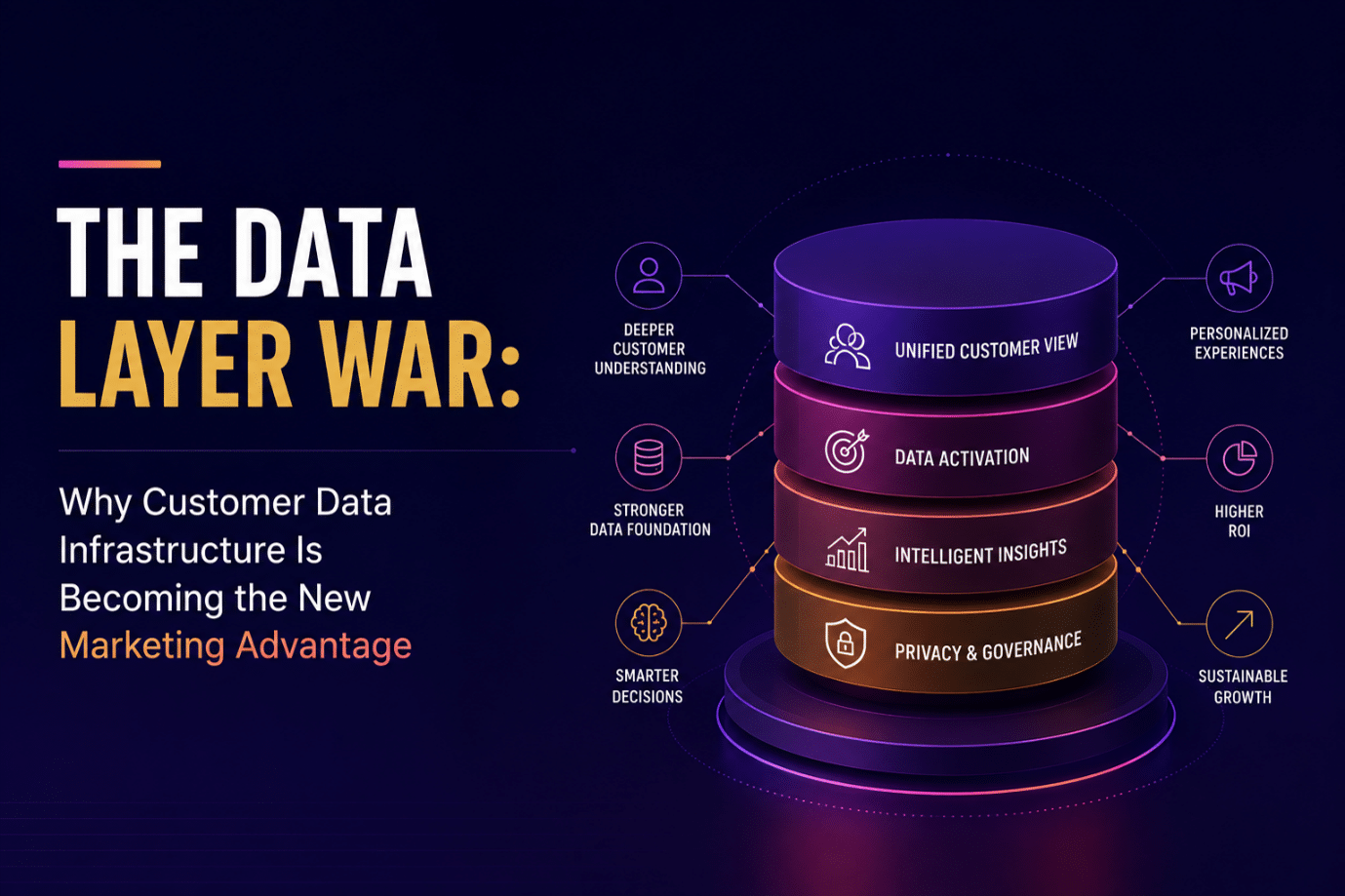
For years, B2B marketing success was driven by creative campaigns, advertising budgets, marketing automation, and expanding digital channels. Organizations invested heavily in content production, demand generation, and performance optimization with the belief that better campaigns would automatically produce better business outcomes. While these strategies remain important, the competitive landscape is changing rapidly. Today, Customer Data Infrastructure is emerging as one of the most important factors determining long-term marketing success.
Customer Data Infrastructure is no longer just a technology initiative; it is a business strategy that enables organizations to unify customer information, improve data quality, and support personalized engagement across every stage of the buyer journey. Businesses investing in Customer Data Infrastructure are building a stronger foundation for AI-driven marketing, customer intelligence, and long-term growth
As digital experiences become increasingly fragmented, privacy regulations continue to evolve, and artificial intelligence becomes embedded into business operations, marketing leaders are realizing that sustainable growth depends less on campaign execution and more on the quality of the data powering every customer interaction. The companies gaining a competitive edge are no longer simply those producing the most content—they are the ones building a unified, intelligent, and scalable customer data foundation.
The concept of a customer data layer extends beyond storing information. It encompasses the technology, governance, processes, and architecture that collect, organize, enrich, and activate customer information across the entire organization. Every website visit, product interaction, email engagement, customer support conversation, purchase history, sales meeting, and third-party intent signal generates valuable data. Most organizations already possess enormous amounts of customer information. The real challenge is transforming that information into reliable, actionable intelligence.
Modern B2B buying journeys have become increasingly complex. Enterprise buyers no longer follow a predictable path from awareness to purchase. Instead, they interact with company websites, search engines, social media platforms, webinars, analyst reports, online communities, AI-powered assistants, executive content, and sales representatives before making purchasing decisions. Each interaction creates valuable behavioral signals, yet these signals are often scattered across CRM platforms, marketing automation tools, analytics systems, customer success software, and product databases. Without a unified view, personalization suffers, reporting becomes inconsistent, and strategic decision-making slows considerably.
Historically, organizations attempted to solve this challenge by integrating various applications and building centralized dashboards. While integration improved connectivity, it often focused only on moving data between systems rather than making that data usable. Customer Data Infrastructure represents a more advanced approach. Instead of simply connecting applications, it creates standardized, continuously updated, identity-aware, and activation-ready customer profiles that can support every department across the business.
This shift has become even more significant with the rapid adoption of artificial intelligence. AI-driven analytics, predictive modeling, automated segmentation, personalized recommendations, and intelligent customer engagement all depend on accurate and connected data. Artificial intelligence cannot compensate for poor-quality information. In fact, disconnected or inaccurate customer data often leads to ineffective personalization, inaccurate forecasts, inconsistent messaging, and poor business decisions. Organizations that invest in robust Customer Data Infrastructure provide AI systems with trusted information, enabling more reliable insights and measurable business outcomes.
Marketing itself is also evolving. Traditional marketing teams primarily focused on campaign management, content creation, and lead generation. Today’s marketing organizations increasingly function as operational intelligence hubs. Teams now manage identity resolution, customer segmentation, behavioral analytics, attribution modeling, activation pipelines, and AI-powered decision-making processes. Their ability to deliver exceptional customer experiences depends on how quickly they can transform raw data into meaningful business actions.
Another major driver behind this transformation is the growing importance of first-party data. As privacy regulations strengthen and third-party cookies continue to disappear, organizations are investing more heavily in collecting and managing data obtained directly from their customers. This strategy is about far more than regulatory compliance. First-party data enables organizations to strengthen customer relationships, improve personalization, enhance measurement accuracy, and reduce dependence on external advertising platforms. Companies that own and manage their customer information effectively are better positioned to adapt to future market changes.
The importance of customer data now extends well beyond the marketing department. Sales teams rely on behavioral insights to prioritize opportunities and personalize outreach. Customer success teams monitor engagement patterns to predict retention risks and identify expansion opportunities. Product teams analyze usage data to improve customer experiences and guide product development. Executive leadership increasingly expects unified business intelligence that combines customer insights across every department rather than isolated reporting from individual teams. As a result, Customer Data Infrastructure has evolved from a marketing initiative into a strategic enterprise capability.
However, building an effective customer data ecosystem requires much more than purchasing new software platforms. Organizations must establish clear governance policies, standardized data definitions, ownership structures, quality controls, and cross-functional collaboration. Without disciplined management, even sophisticated technology can create additional complexity instead of delivering meaningful insights. Leading enterprises increasingly treat customer data as a strategic business asset, complete with measurable quality standards, defined ownership, and continuous optimization processes.
As digital transformation accelerates, organizations that prioritize Customer Data Infrastructure will be better equipped to respond to changing customer expectations, strengthen data governance, and deliver consistent experiences across marketing, sales, and customer success. Investing in Customer Data Infrastructure today prepares businesses for a future powered by trusted data and intelligent automation.
Looking ahead, the companies that achieve lasting competitive advantage may not be those launching the highest number of campaigns or generating the greatest volume of impressions. Instead, success will belong to organizations that understand their customers with greater accuracy, respond to behavioral signals more quickly, and activate insights across every customer touchpoint. Marketing advantage is becoming increasingly architectural rather than purely creative. As businesses continue investing in digital transformation and artificial intelligence, Customer Data Infrastructure will serve as the foundation that enables sustainable growth, operational efficiency, and superior customer experiences. The data layer is no longer just an IT concern—it has become one of the most valuable competitive assets in modern B2B marketing.